How to Balance Your Cue: One Simple Ratio to Get the Most Out of It
The same great cue can feel front-heavy or dull if the weight is wrong. Use one number, shaft ÷ butt, to find the balance that suits you.
When choosing a cue, most players carefully compare brands, woods and shaft construction. All of that matters, but one thing often gets overlooked: weight balance.
Set up well, a cue feels smooth, powerful and the cue ball does what you ask. Set up badly, even a great cue feels awkward.
The cue sets the ceiling; the balance decides whether you reach it
Think of a cue like a car:
- The cue's character (wood, construction, taper, shaft) is the car's performance: it sets how good the cue can be.
- Weight balance is the tuning. Get it right and you use all of that performance; get it wrong and even a great car drives badly.
Buying a good cue is only step one. Tuning the balance to suit you is what lets the cue reach its full potential.
One formula is enough: shaft ÷ butt
The simplest way to judge balance is the weight ratio between shaft and butt:
Shaft weight ÷ Butt weight = Balance ratio
Example: shaft 3.9 oz, butt 15 oz: 3.9 ÷ 15 = 0.26.
Ounces or grams both work, as long as you use the same unit for both. Weigh the shaft with its tip and ferrule.
What do the numbers mean?
- Below 0.24: dull. The butt is too heavy and the shaft too light; the stroke feels dead and the cue ball reacts slowly.
- 0.24–0.25: lively. The cue ball reacts noticeably faster and the stroke feels crisp.
- 0.26: balanced. Power and speed are even; the most comfortable spot for most players.
- 0.27: powerful, but the limit. It hits hard, but do not go any higher.
- Above 0.27: front-heavy. The shaft is relatively too heavy and the cue becomes hard to control.
Think of 0.27 as a speed limit: right at the limit feels fast and exciting, but past it you are breaking the rules. So the comfortable range is 0.24 to 0.26, and 0.27 is the red line.
Where you sit within 0.24–0.26 depends on your stroke: if you like a quick, light-feeling cue ball, aim for 0.24–0.25; for a balance of power and speed, 0.26 is the safest choice.
Calculate your ratio
Ounces or grams, just use the same unit for both.
Enter your shaft and butt weights to see your ratio.
Ratio off? How to adjust it
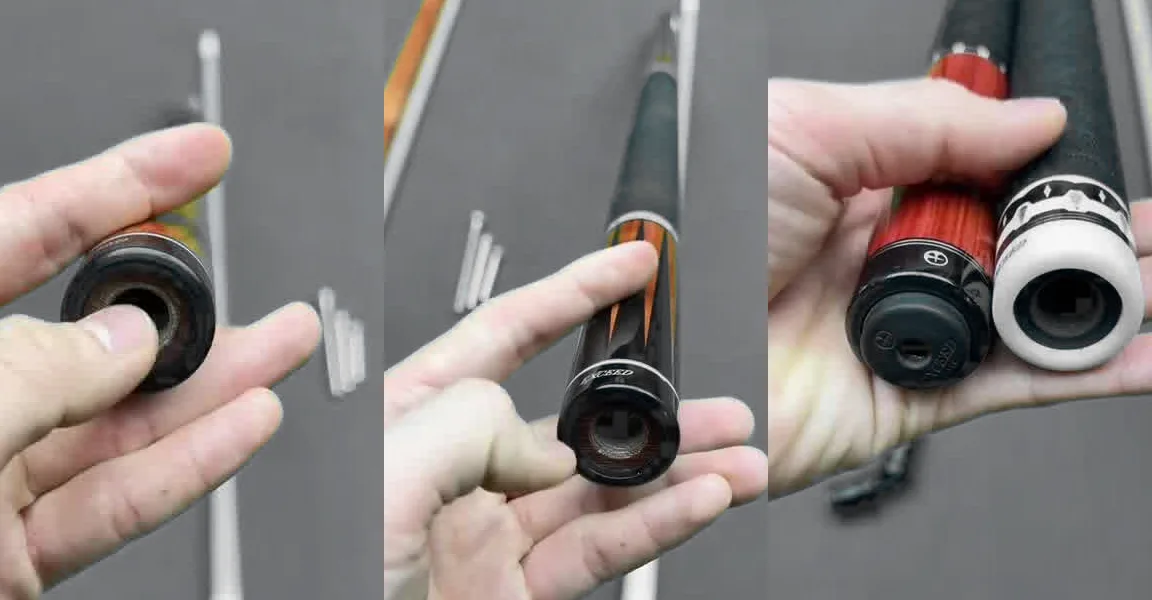
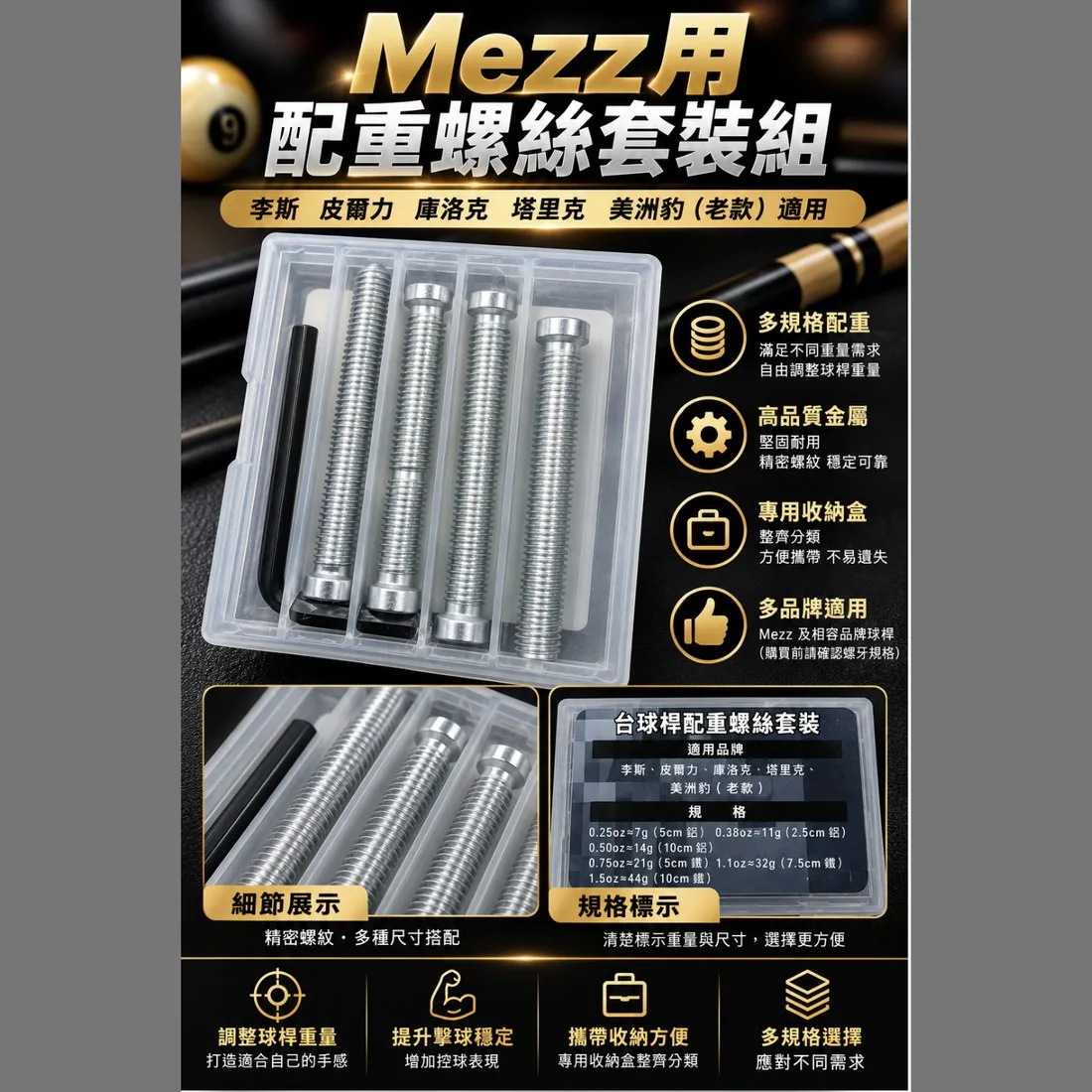
You usually leave the shaft alone and adjust the weight bolt in the butt:
- Ratio too high (front-heavy): add weight to the butt and the ratio drops.
- Ratio too low (feels dull): remove butt weight and the ratio rises.
Remember that changing the butt weight also changes the total weight of the cue. Adjust a little at a time and play with it for a while before changing more.
How to weigh
Unscrew the shaft and butt and weigh each on an ordinary digital scale (a kitchen scale is fine), then use the formula above.
Not sure which weight bolt you need? Send us a photo of your cue on LINE, Zalo or email and we will help.
A good cue deserves the right balance
A cue's character is the foundation, but what really decides whether it feels right in your hands is often the balance. Spend a little time getting the ratio between 0.24 and 0.26, at the spot that suits your stroke, and the same cue may suddenly feel much easier to play.
Weight bolts: Mezz weight bolt set, Mezz EXCEED Gen 2 weight set, Predator weight set, Cuetec weight set, Musashi weight set.
Questions about your cue? Message us on LINE, Zalo or email.
LINE · Zalo · Email